Omer Counting Season 2025

Chag Pesach Sameach, friends, and I hope that 2025 finds you safe, well tended, and meaningfully engaged with the current world in ways that are manageable and sustainable and brave.

Counting the Omer is going to be a quiet process for me this year after a busy and excited process of offering something new last year. I’m meeting my body and life where they’re at, while still looking forward to having a daily touchstone for the next several weeks, perhaps one that will sharpen my sense of self, my sense of place in the world, and my sense of right next steps toward a continued fight for collective liberation.

Last year, I started a Discord server for counting, but given the pace of sharing and my capacity this year, I’d like to offer something smaller – a simple chat group on Signal (reply to this email or message me with questions or you can simply join via this link). Feel free to hop in and read, listen, share, whatever comes to you. I’ll be reading from different Omer counting resources, maybe sharing bits of my own process, and enjoying what everyone else might want to bring to the space.

If you enjoyed my weekly pdfs from last year with a coloring page for each of the sephirot, you can grab any of those here on a shared drive. If you want the entire coloring journal that I released last year, I still have both physical and digital copies of Omer Reflections.

Here are some other resources for counting the omer that I’ve gathered over a handful of years:

I won’t be emailing weekly, but wanted to share some starting points, whether you like what I’ve created or want some other options to explore, and I would (as always) love to hear how this seven week process unfolds for you, especially in this current moment.

Remember that the actual counting of the omer is actually a very simple and quick process daily, so if you get bogged down with supplemental resources or a practice you can’t sustain, the counting itself is simple and accessible and enough. I believe that the counting magic has the capacity to unfold within us regardless of what external creative process we build around it. I hope to see you on the other side.

Much, much love,
Yaakov
Originally posted via the newsletter

Elul Week 2 – The next 7 names toward return

Hello there,

I hope that second week of Elul have been meaningful in all the ways you’ve hoped for. My kiddo and I came down with COVID, so you’re getting this weekly email in loosy-goosy late fashion while I am slowly recovering.

This daily practice that my friend Leia and I have been exploring continues to really supportive for me, both in thinking about my reflections and in creating a framework for these reflections to be part of my yearly cycle of Jewish practice.

Reminder of the process: Each day, I awaken to find which name of G-d Leia (who is 14 hours ahead of me) chose to reflect on next, marvel at the resulting collage art (which I’ll let Leia share if they wish), then I intuit some questions for myself about my relationship to that name and how I embody that name, I spend time with those questions, and then I create a prayer to that name that I try to carry with me through the day.

[Here are the Week 1 names if you need them.]

Here are the next 7 names we’ve explored so far, and what grew from that exploration with a reminder that it’s still in a first draft form. Feel free to engage with these questions and prayer for personal use – journaling or pondering, or to create a personal practice that better suits your journey.

List of names for this week, details below, with mountain image in the background

Yedid Nefesh — יְדִיד נֶפֶש – Soulmate / Soul Friend

  • Do I enter my relationship with the divine, with myself, with others, with hope and openness for a deep and lasting connection?
    • Am I a friend who, in safe and reciprocal relationships, relies on others and is reliable as well?
    • Have I cultivated and tended relationships in which I feel able to be seen at a soul level, where I feel known deeply even if the way I present myself to the world changes?
    • I ask Yedid Nefesh to hold me like a lifelong friend, modeling a love I can then embody, one that welcomes being held and seen, and also holds me responsible for the holding and seeing of others.

Avinu / Imeinu — אָבִינוּ/ אימינו – Our Father/Mother/Parent

  • Have I grappled with the difference between simply being older and earning the title of elder? Do I carry this nuance into how and when I defer to someone older or challenge and grow forward from their stopping point?
  • Do I reach for wisdom with humility, knowing that the true elders in my life offer lived experience and knowledge upon which I can build? 
  • Do I allow myself to be held safely and nurtured by knowledge I don’t yet possess, when the source embodies this face of G-d?
  • Am I able to hold parenthood complexly, whether in this divine name, in my own parents, or in my own parenting, reaching for wisdom while also knowing my role in furthering and refining the role of parent?
  • I ask Avinu / Imeinu to comfort and guide me with a presence that demonstrates wisdom and encourages me to build upon it, creating my own trajectory toward earned elderhood.

Eli — אלי – My God

  • Have I identified and reached for the face of G-d most readily in my line of vision? Have I done the same in seeking solutions, connections, and support?
  • Do I reach for accessible presence, whether from G-d or from others, investing myself in relationships that are divine by way of their availability and intentionality?
  • Do I remember to embody my own potential to be a source of divine presence in the lives of those in my immediate vicinity?
  • I ask Eli to help me and guide me and challenge me from up close, and direct me in balancing my level of seeking so that I am never turning away from support or responsibility that is already right in my backyard.

Elohei Avoteinu — אֱלֹהֵי אֲבֹותֵינוּ –God of Our Ancestors

  • Have I grappled with what has been handed to me by way of prior generations, both in my own lineage and the long history of the Jewish people?
  • Am I living a life toward being an Ancestor, someone who has lived and died well, who has grappled their history and endeavoured to build upon it intentionally?
  • How do I wrestle in that sacred Jewish way to reconcile the Judaism of my ancestors with the Judaism I am living forward? How do I also wrestle with these layers of my personal lineage beyond Judaism?
  • I ask Elohei Avoteinu to hold, challenge, and enlighten me within the long lineage I carry within me, so that I may embody the best of my ancestors and heal/repair what they did not.

Shekhinah — שְׁכִינָה –The In-Dwelling Presence

  • Have I carried well the part of divinity that makes a home within me? Have I done my best to earn the trust of my most sacred inner cohabitant through my actions in the world, toward myself, and toward others?
  • Do I show up in the world carrying the responsibility of inner sovereignty while also deeply respecting and protecting the sovereignty of others?
  • How often do I remember that the sacred progress I wish to see in the world often starts with me and my embodiment of that potential?
  • I ask Shekhinah to nurture my sense of what is divine within myself, so that I show up in the world with the energy of that sacred presence fueling my best actions for myself and the world.

El Nora (Nora’ah) – אֵל נוֹרָא – The Great One/ The One Who Inspires Awe

  • Have I taken time to truly marvel at the world, at people, at nature, and at my part of the whole? Do I allow and even prioritize this kind of amazement as a way of balancing what is disappointing, painful, or enraging?
  • Do I take time to intentionally reach for the face of G-d that reminds me of the scale of it all, that places me in view of the true proportion of all things and my place among them?
  • I ask El Nora to astonish me with a sacred vantage point that can help me to feel less alone, less solely responsible, more possessing of a balanced ego and awe-inspiring sense of my role in the world.

Ehyeh Asher Ehyeh — אֶהְיֶה אֲשֶׁר אֶהְיֶה‎ – I Will Be What I Will Be / Sacred Emergence

  • Have I been willing to blossom in the right time, and without struggling against my natural growth cycle? Have I also allowed this of others?
  • Do I recognize and celebrate when I have unearthed something new in myself? Do I show up and integrate those system upgrades in myself and in those I love?
  • Will I use exactly who I am, in the divine image of this name of G-d, to show up in the world with the responsibility of a fully formed divine creation, refusing to wait until some unknown point of unattained change?
  • I ask Ehyeh Asher Eyheh to help me in being exactly where I am and exactly who I am, in recognizing which petals or leaves are ready to unfurl and which are growing without any need to strain toward that a premature blossoming.

Reminder of other places that I’ve found Elul offerings/spaces, if you’re still looking:

IAlso, these are places toward which I’m aiming my daily funds so far:

  • The Sameer Project – Donation-based iniative for Gaza led by Palestinians
  • Operation Olive Branch – Donations to a different GoFundMe for each day
  • eSIMs for Gaza – At each week mark, I’m checking the balance on eSIMs I’ve already donated to top them off, and purchasing a new one. (I use Nomad and my referral code YAAK32CY will save us each 25% on purchase of a future eSIM.)

Offered as a launching point for another week: The name chosen by Leia for Elul 15 is Moreinu, or Our Teacher, followed by HaMakom, or The Place, and Kol Dimama, or Still Small Voice.

Wishing you a meaningful week 3,
Yaakov

Originally posted on the newsletter.

Elul Week 1 – The first 7 names toward return

Hello there,

I hope that this first week of Elul have been meaningful in whatever ways you’ve hoped for.

The practice that my friend Leia and I have been exploring for the first time this year has been magical for me so far, and while I don’t have capacity to share any of it as daily fully-fleshed out offerings, I want to share the past week as a launch point if you were intrigued by the idea I shared last week but don’t know where to start.

Each day, I awaken to find which name of G-d Leia (who is 14 hours ahead of me) chose to reflect on next, marvel at the resulting collage art (which I’ll let Leia share if they wish), then I intuit some questions for myself about my relationship to that name and how I embody that name, I spend time with those questions, and then I create a prayer to that name that I try to carry with me through the day.

Here are the first 7 names we’ve explored so far, and what grew from that exploration in a first draft form. Feel free to engage with these questions and prayer for personal use – journaling or pondering, or to create a personal practice that better suits your journey.

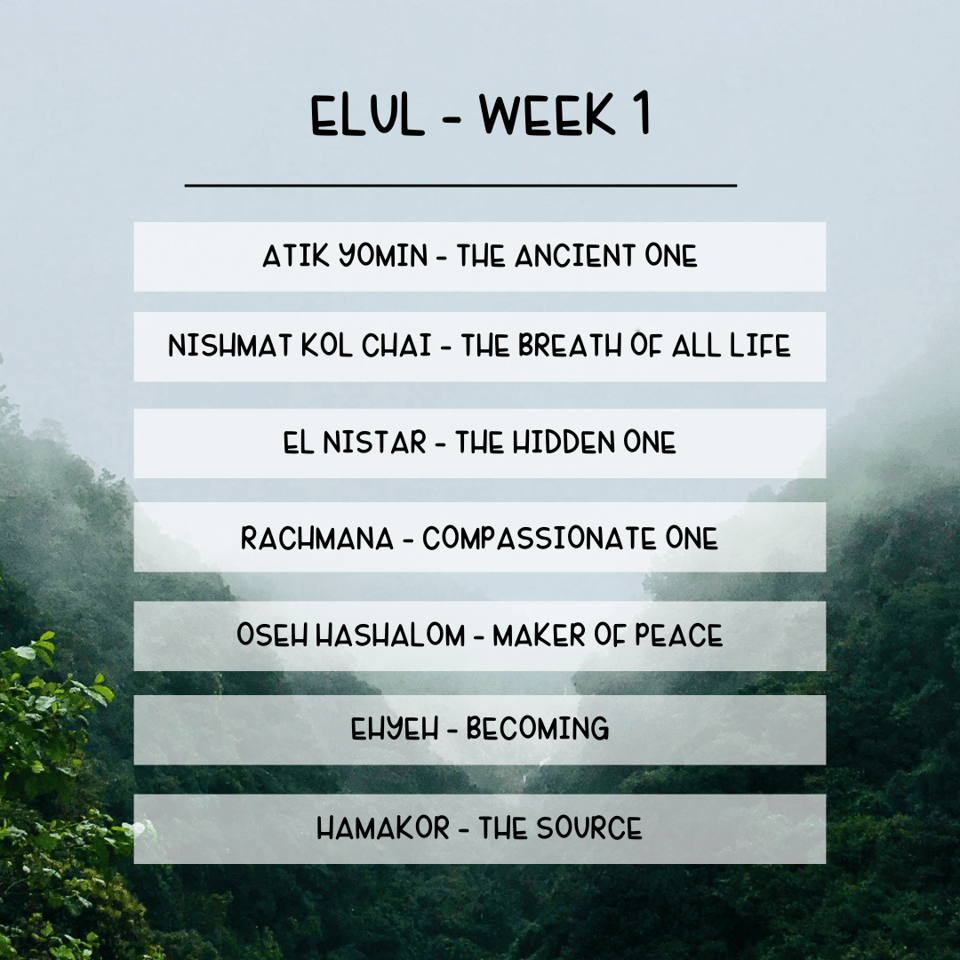
[List of the first 7 names over a foggy mountain background, detailed further in the text below]

Atik Yomin — עַתִיק יומין  The Ancient One

  • Have I considered the long term impacts of my choices and behavior? 
  • Have I reached for available wisdom in order to take action that connects to long range efforts, such as collective liberation or personal work in healing my lineage?
  • How will I carry a reverence for eternity as I continue to navigate my chapter of an ancient collective story?
  • I ask Atik Yomi to help ground me in a timeline much longer and greater than myself.

Nishmat Kol Chai –  נִשְׁמַת כָּל חַי  The Breath of All Life

  • How have I allowed my breath, shared with All, to ground my movement through life? Do I remember to breathe?
  • Have I used my portion of collective breath well, through right actions and words, and taking only my share of space in any room? 
  • How do I want to use my breath in the coming year?
  • I ask Nishmat Kol Chai to hold me in the breath of the collective, reminding me that I am not alone.

El Nistar — אל נסתר –  The Hidden One

  • How have I worked to unearth what I needed to know in the past year? What revelations have resulted from all that I’ve discovered?
  • Have I carefully held and been worthy of trust in my relationships? Do I hold carefully the hidden and tender parts of myself and others?
  • Do I allow revealing to happen in its own time? Do I avoid dragging to the light what is not yet ready to emerge?
  • I ask El Nistar to build my strength and trust through holding me from a hidden place, secure even in the Face most hidden from me.

Rachmana — רַחֲמָנָא – Compassionate One

  • Have I remembered to fuel my capacity for giving grace with a gentle compassion for self?
  • Do I reach for the gentle embrace of a compassionate G-d? Do I look for a gentle face as often as I look toward a fiercer, bolder face of G-d?
  • I ask Rachmana to offer me both compassionate holding and the capacity hold others with the same divine grace.

OsehHaShalom — עוֹשֶׂה השָׁלוֹם- Maker of Peace

  • Do I reach toward a divine presence capable of making peace with my own willingness to contribute toward its creation, both internally and in the world?
  • Have I contributed toward a goal of peace in my personal, spiritual, and community-based practices, thereby embodying the Peacemaker?
  • I ask Oseh HaShalom to weave within me a roadmap toward a kind of peace that starts in the work of building a community that creates and protects its member’s internal peace, including mine.

Ehyeh — אֶהְיֶה‎ – Becoming

  • Have I worked toward betterment of myself and the world, while remembering that both are never complete? Do I fuel myself for labor that doesn’t end, but is always changing?
  • How can I reach for the grounding momentum of navigating an existence that has always been in a process of becoming? Can I allow that constant, deeply divine motion to release me from a need to be “complete?”
  • I ask Ehyeh to help me embrace and root deeply within the constant motion that is life.

HaMakor — המקור – The Source

  • Do I look for the roots when I am unsure of myself, of a right choice, of the heart of a matter? Am I willing to dig for all that I need to know?
  • Am I willing to create what is not yet available to me, when it is possible? Do I embody Source by being a part of something new?
  • I ask HaMakor to help guide me toward the deep inner source that feeds my roots and allows me to be a powerful source in the image of The Source.

I’ll share again some other places that I’ve found Elul offerings/spaces, if you’re still looking:

I mentioned last week that part of my Elul practice is also tzedakah, and I’ll share the places toward which I’m aiming my funds so far:

  • The Sameer Project – Donation-based iniative for Gaza led by Palestinians
  • Operation Olive Branch – Donations to a different GoFundMe for each day
  • eSIMs for Gaza – At each week mark, I’m checking the balance on eSIMs I’ve already donated to top them off, and purchasing a new one. (I use Nomad and my referral code YAAK32CY will save us each 25% on purchase of a future eSIM.)

Offered as a launching point for another week: The name chosen by Leia for Elul 8 is Yedid Nefesh, or the Soulmate / Soul Friend.

Wishing you a meaningful week 2,
Yaakov

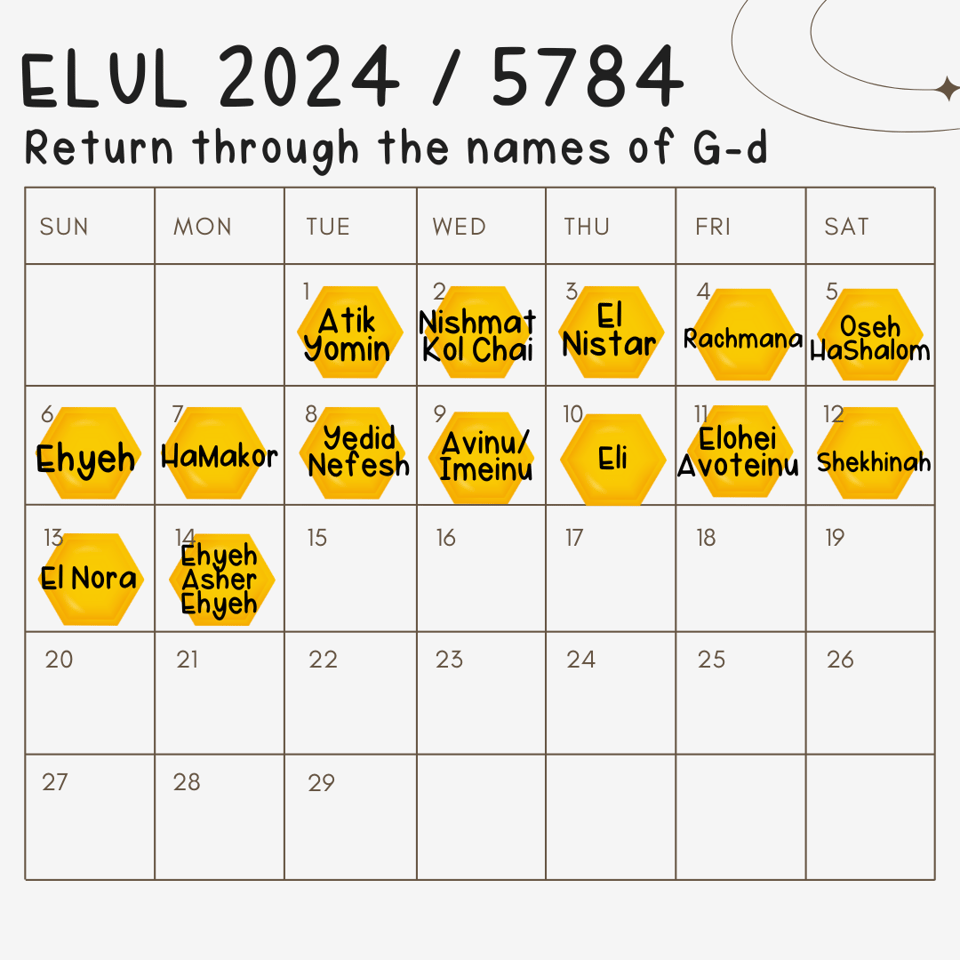
[Monthly calendar view entitled “Elul 2024/2025 - Return through the names of G-d” with the first seven names placed on the corresponding date.]

Elul practices & new art

Hi there!

I hope you’ve been well since I last pestered you during the counting of the Omer. It was absolutely amazing to share this year’s counting with so many people through an offering that you all received with so much love. It leaves me excited for all of the Omer counting seasons to come!

I’ve long wanted to find a similar practice for the month of Elul, but I’ve never landed on my practice, one that feels right in the way that counting the Omer does. I love blowing the shofar, I’ve spent some time with Psalm 27, and I’ve enjoyed a lot of different offerings each year, but my personal practice hasn’t fully solidified.

This year, in musing about the month and past practices, I mentioned off-hand to my dear friend Leia that I’d been toying with the idea of reflecting on one of the names of G-d for each day of Elul, looking at my relationship to that face of G-d, how well I’ve embodied those traits in my life over the past year, and how I might better embody that face of G-d in the coming year.

Things took off from there, and we’re doing the thing! I think that this year will result in something that we’d like to offer others, but for this year I just want to offer the idea and welcome you to incorporate it into this month in any way that resonates for you.

(My overview for Elul practices this year)

Here are some other ways that I connect with this time of year, if you’re looking for ideas:

There are dozens of amazing offerings, and if there are practices you’ve come to love, I would welcome hearing about them. I may be sharing my process with the daily name reflections along the way, probably on Instragram if I do, but as this is new, I don’t want to promise a fully fleshed offering. Maybe in 5785!

I also wanted to share the news that my art was selected for the 5785 edition of the Radical Jewish Calendar and I’m honored and excited to be a part of this year. If you haven’t already ordered yours, go snag one! This year, 18% of sales are going to Palestinian-led organizations and movement work.

This is my piece, which was chosen for the month of Sivan:

Digital drawing of Bisan seated and smiling toward the camera in a press vest with “Free Palestine” written down her right arm, the quote “It is our right to live. -Bisan Owda” to her right in white letters with a red background, and the background of the piece is green leaves over solid navy.

My caption/note that accompanies the piece:

This piece is an attempt to honor a powerful Palestinian voice, one of many voices witnessing their people’s truth at a volume that refuses to allow the world to look away from genocide and an occupation that must come to an end. Bisan’s statement should not be a revolutionary idea, but it is worthy of a revolution. Sivan is a time of preparing to receive Torah, of gathering wisdom. Can we ever fully step into wisdom when we are not all free?

I hope that Elul contains gentle wisdom that carries each of us safely and firmly toward not just the upcoming year but a better world to come.

Chodesh tov,
Yaakov

originally shared via the newsletter

Print Copies & a wee Discord server

Hello!

The print copy of the Omer Reflections Coloring Journal is here! I’ve already made several trips to drop off piles of packages and I’m so grateful for the love that this offering has already received.

If you’re looking for other Omer counting resources or you’d like to count in community, I’m launching a tiny seasonal Discord server for folks to share along the way, ask questions, remind each other to count, and just meet other Jews.

The server will be seasonal in the sense that I will turn it off/archive it after Shavuot, so that it’s not one more social setting you’ll need to tend outside of this time of year. I’ll host some quiet evening coloring sessions here and there, and there are rooms for coexisting in different ways (no audio body-doubling, audio-only live chatting, text chats, and even recorded voice messages with a bot to transcribe for better accessibility).

Wishing you all as much ease in the days leading up to Passover as is possible in the world in which we live.

Things I’ve found useful or worth noting in some way recently:

  • Jewish Prayers for Gaza – found through Tzedek Chicago’s services and have reached for these often during the week
  • Pillar of Fire Haggadah – this is a beautiful offering for Passover, and I’m lucky to have some pages from the Omer Reflections Coloring Journal featured in it.
  • Gashmius Haggadah Companion – another beautiful Passover offering
  • Omer Calendar of Biblical Women – I preordered this and it’s a really gorgeous book, psyched to add it to my already sizable Omer counting book collection.
  • Radical Jewish Calendar 5785 – There’s a call for artist submissions and the deadline is this Sunday!
  • JVP’s “Passover During a Genocide” – “JVP has compiled these offerings so we may continue the sacred work of mobilizing to end genocide and apartheid — and of building an expansive practice of Judaism beyond Zionism.”
  • A Shulchan Orech Pledge for Passover – “This year, we will not fulfill the requirement of Shulchan Orech by eating a festive meal while the weaponized starvation of the Palestinian people is taking place.” Actions to take and resources.

Wishing you an early Shabbat Shalom,
Yaakov

Cocoon Exit & New Offering

Hey there,

It’s been a long while. 2023 attempted to fling this Jew off of a COVID cliff, but after several months in a forced-then-self-imposed cocoon I am reemerging, upgraded from chronically ill to disabled, sporting new diagnostic answers like badges on a scout sash, and garbed almost constantly in t-shirts that flip the bird literally or figuratively at something.

I have clearly maintained a sense of humor. Just ask my sticker and t-shirt collections.

Yaakov from the neck down, wearing a beige cardigan over a maroon tee that has the wheelchair symbol for disability and reads "I still run better than the government"
Current favorite is this maroon tee that reads “I still run better than the goverment”

It’s hard to know what to share to bring this newsletter into the present. I won’t try to pull all of you through every notable point in time since my last ramble, but here are some of the highlights:

  • I completed a second year of counting the Omer and really clinched my identity as an Omer Jew. Last year’s process was really an anchor during a time when I needed it, and my crew of counting comrades grew in number in a really great way.
  • We added a second fur buddy to our family last summer. His name is Romeo and he is a very sassy gentleman. He has an uncanny ability to know when I need to sit down despite having no training as a service dog whatsoever, and he sits very still for his priestly blessing on shabbat.
  • I recent left my local synagogue, which was a really difficult decision, and then I shared about it, which was really scary but resulted in overwhelmingly supportive DMs and comments, proving that sometimes saying the vulnerable stuff is what confirms we’re not even close to alone. The experience also gave me hope for what future Judaism looks like and how many of us want to get there.
  • I designed and launched fundraiser apparel on Bonfire that generates funds for the Rachel Corrie Foundation. That offering is up and running indefinitely, and my tee and sweatshirt have both held up well, quality-wise, even with frequent wear.
Image of Yaakov's sweatshirt (no face, just front of shirt), black with a red Magen David made of watermelon slices with olive branches in the middle
Unplanned but handy for a snapshot: I’m currently wearing the sweatshirt
  • I recently had some creative content and my recently created custom digital Hebrew font chosen for inclusion in Pillar of Fire, a haggadah I’m excited to be a part of. Pre-orders are open now for this resource that will help some of us navigate Passover in really meaningful ways. My very talented friend Jay is featured as well!

So, those are the highlights I can think of over the past year. On to the big thing.

The last thing isn’t a thing to catch up on… it’s a NEW THING. I really wanted to create an offering for counting the Omer this year and everything has aligned in time for me to be able to really focus on it for the past few weeks and actually launch this year, thanks to a new connection with Pushcart Judaica (more on that to come as we get things up and running).

I’d like to introduce you to…

The Omer Reflections Coloring Journal.

Mock up of the cover of Omer Reflections Journal displayed on an iPad on a surface of light colored wood
Mock up of the print copy of Omer Reflections Journal displayed on a surface of light colored wood. The journal is bound with clear spiral.

I am REALLY excited to share an Omer counting resource after two years of making friends, art, and new realizations about myself and my Jewishness every year between Passover and Shavuot.

I’ve tried to include some primers, nods to the resources that I’ve enjoyed, artwork and written reflection from my own Omer counting, space for creativity (coloring pages!) and room for note-taking.

There are also two extra ways to buy the digital version that allow you the option to share the digital files with 3 or 4 friends, encouraging that folks create a chevruta vibe and build community through counting.

Print and digital mockups of the Omer Reflections Journal on light colored wood with additional text showing the chevruta packages, mentioning that print copy purchasers will receive the digital for free

Alllllll of the info on this offering can be found here, including a link to purchase a copy if you’re so moved.

The digital copy is available right now and the print copies will be available for sale very soon, copies likely shipping this weekend and next week!

If you stick with me here in this email space, I’ll be sending out some digital Omer counting goodies from the journal every week so that everyone can have a little something to spark continued counting throughout. I’m mulling over some additional ways that we can connect while counting as well. Stay tuned!

Let’s count, color, create, and communicate when the time comes! More soon.

L’shalom,
Yaakov

Making Space to Find the Lighthouse

I’m inspired by @julesavivrose to share most of the letter I sent two weeks ago, withdrawing membership from my local Zionist congregation, including my child’s enrollment in chadash, where we eventually discovered the root of some mysterious issues that had been going on (not just at chadash but on the bus as well) had to do with our family’s pro-Palestine stance. I omitted some bits that were about my kiddo or that reveal personal details, but this is 90% of the letter.

The day I sent this was a really hard day, including deep disappointment in the quick and very brief response from the rabbi (no response at all from the chadash director), but I’ve realized in the two weeks since sending this that the agonizing over whether to leave was taking up all of the space in my life where Jewish practice had been.

I’ve created more art, studied more Torah, and enthusiastically attended more services and Jewish gathering in these two weeks than in the several months prior. A local friend sang the praises of @tzedekchicago, so I went to their Shabbat service the same night I sent the letter and I immediately felt at home.

This year feels like a big, BIG lesson about the aching, tunneling wound that is made by a person trying to fit in spaces that don’t want all of that person. I may have spent just a week in the hospital fighting sepsis in the end of February, but I have been septic with a lack of true community for months, and sending this letter cleaned that wound and made space for healing, for the medicine of finding a new Jewish home where I had finally made space for one.

I have worried in recent months that being anti-Zionist would eventually cost me my Jewishness, and it has definitely cost me a community that I thought I needed, but finding truly aligned and safe community has allowed me to feel more Jewish than I have in a long time. Thankful to @wabbi.wosen and @tzedekchicago for being the lighthouse a lot of us need right now.

Shavua tov. Chag sameach. Free Palestine. Wear a mask. Zionism isn’t Judaism and liberal zionism isn’t a thing. Good night.

Opening Lips & Facing the Darkness

Wow, it’s been a minute or several since my last email. Winter has been quiet and reflective and heavy, but I’m still here. Chanukah was beautiful and quiet and lovely, I finished some shabbat-inspired artwork, I went to visit my grandmother’s grave on her yahrzeit amid a beautiful day of timely fog, I took a moment to remind us all that trans people are divine, and as my kiddo’s winter break ended I was so glad to see Torah Studio classes begin again.

Here are my sparse notes from this week’s class on Psalm 51:

Middle text reads "open my lips that my mouth may tell your praise. - Psalms 51:17" and there are smaller notes all around this text. One says "easily recognized part of liturgy," another says "Help me be willing to be willing," another says "help me to speak, help me to even say it," and the last says "Why open lips? Does David struggle to be remorseful or worry that his amends won't be enough?" Yaakov's instagram handle is on the right side reading @Yaakov.Akiva.

I don’t know that I had ever thought about this line in terms of a concept I’ve heard often in recovery spaces, that sometimes praying for willingness to be willing comes before anything else. Naming it in order to begin taming it. Say the thing in order to be seen and feel held within whatever is happening for us. I can think of so many instances when just naming what is happening/what happened is such a powerful place to start… depression, trauma, starting the process of amends, addressing any needed change. This line has whole new layers of meaning for me now.

And this is the culmination of two week’s of art-making based on last week’s parsha and this week (Parshat Bo):
There is a crystalline piece of hail with a glowing round flame in the middle, red in the center and orange-ish red around the flame's edges. Tracing the outside of the hail is the quote from Parshat Bo, "And there shall be a loud cry in all the land... such as has never been or will ever be again" and all of this is surrounded by a solid black background. The art is signed on the edge of the hail with @yaakov.akiva.

I started this last week as a visual representation of the hardened heart as the hail that held flame, and then this line from this week’s parsha and the tangible darkness brought it all together.

Thinking about a heavy, oppressive darkness felt in the presence of hardened hearts feels so relatable right now. I thought a lot last week about hardening a heart in power because those responsible for change are the community, a public being tasked with immense change in spite of power, and that we as community are in so many ways struggling with and often failing at that task just as much as those who did during the exodus.

Wishing you all the kind of shabbat you need this week, whether it’s restful, playful, contemplative, or some other vibe entirely. You deserve it.

Shabbat shalom, or if you’re catching this after, shavua tov.

Yaakov

Originally posted via the newsletter

Originally posted via the newsletter

Vayeshev’s Dreamer & Judith’s Resistance

SHABBAT SHALOM, DREAMERS. <3

I’ll mostly let my notes on Parshat Vayeshev speak for themselves, but let it be known that I’m firmly in the camp of Joseph being a neurodivergent, gender expansive, queer dreamer I can relate to, whose story is itself a dream that reveals MUCH about the interpreter… us.

How we read Joseph is incredibly telling, maybe moreso than anything other ancestor. I know that my own lens is tinted by my own identity as a neurodivergent, gender expansive, queer dreamer with my own trauma and my own deeply complex and fraught family story, and from that angle this story is one that contains really powerful moments of witnessing my own story and healing, especially in the week’s to come.

Questions for pondering:
– Do we protect, encourage, or resent and judge dreamers?
– How do we each tend our own inner dreamer?

HAPPY CHANUKAH!

I have exciting news for Chanukah season, which is that I will have art included in the winter quarterly publication from Yente, an awesome UK-based, queer, Jewish student-run, creative collective. This edition is centered around Judith, the less often celebrated heroine of the Chanukah season. Highly recommend reading about her, but my quick recap will help frame understanding of the art I submitted, which I’ll share below.

My retelling of Judith’s Resistance:

Once upon a time, there was a widow with a great deal of chutzpah who was surrounded by her beloved people whose city was under siege and by the Assyrians, led by a general, Holofernes. The city ran out of water and the men decided to ask HaShem for help and then wait longer for water to appear, but Judith would have none of this and took delicious cheese, wine, and her chutzpah and she said to the men, “Listen to me and I will do something which will be remembered throughout all generations among the children of our nation.”

Then, she went to the enemy camp and gave delicious, salty cheese to the general, Holofernes, until he was compelled to drink tremendous amounts of the wine she offered, more wine than he had ever had since he’d been born, and upon his succumbing to the effects of the wine and losing consciousness, Judith took the general’s own blade and cut off his head, returning to her people with his head, and eventually reclaiming the land and the water. And thus, she is indeed remembered throughout the generations.

I hope that your Chanukah musings might include honoring of the incredible resistance and fortitude of a woman who knew what to do and saved her people through her resistance to both the passivity of the men leading her people and the oppressive forces that endeavored to kill her people through theft of life-giving, soul-nourishing water.

My depiction of Judith’s Resistance:

You can order your own copy of the Judith edition of Yente here:
UK Ordering | International Ordering

I’ve also quickly uploaded this piece for purchasing a print, sticker, etc.:
Judith’s Resistance on Redbubble

I’m wishing all of you who read these little bits of musing so many lovely nights of light, warmth, family, fried potato goodness, and a refueling of your own Judith-flavored chutzpah during these upcoming days.

Chag urim sameach!

Yaakov

Originally posted via the newsletter

Psalm 46 Invites Surrender & Yaakov Wrestles

Shabbat shalom!

This is a long one, because I got to study a new favorite psalm AND revisit my favorite all-time parsha in one week. Friggin’ fantastic week as far as Jewish study goes. Literally everything else about this week can kindly consume a sizeable satchel of Richards.

ahem

Anyway.

Psalm 46: Invitation/Reminder to Surrender

Psalm 46 earned a bookmark for frequent reference after this week’s discussion with Lexi and the Torah Studio crew. There is so much here, but notably no plea for rescue, nor is it an invitation to bypass the reality of the world, or to ignore the life-giving and destructive nature of existence or the Source of that existence. 

What we create collapses. Divine creation also collapses. Source looms among us and our creations. Source looms upon the earth. Creation was made to collapse, and we are made in the image of the Source of creation, collapse, and destruction, with a reminder to look toward the next creating rather than attempting to deny what has befallen us. 

The reader is reminded in this psalm that our fortress is the G*d of Yaakov. Not of Moses or Abraham or of today. Specifically of the ancestor who wrestled with life, wrestled with G*d, wrestled with identity, and had not yet fallen into their new name. 

We are invited to surrender to reality within a fortress for messy creations, wrestlers who don’t yet have answers, children of messy ancestral creation stories, collapsers of kingdoms, imaginers of new ones. I came away from the excavating of this psalm with a prayerful version of it that I now carry within myself:

May I surrender to reality in order to actively wrestle (within myself and in the world) toward divine relationship with reality’s Source.

May I acknowledge what is true in order to respond with the next right action that will increase my right relationship and proximity (and the proximity of my community) to the divine Source of creation. May each of next right actions propel this world toward the one to come.

Parshat Vayislach: Jacob Wrestles Into New Being

This is my favorite week of parsha study, because Parshat Vayishlach is my favorite Torah portion. It inspired my final essay for my conversion during my first round of studying, Jacob’s moments of wrestling and reunion are the reason I chose my name, Yaakov.

It’s been interesting to start the week thinking about surrender in Psalm 46 and then hold that recent internal wrestling while re-reading this moment of divine wrestling before returning home, coming full circle, following a complex life back to the first partner Jacob ever had, his brother.

The reunion itself is such a moment of surrender… “Family trauma, am I right? Let’s just be brothers, my guy.” (My imagining of one way it would go today.)

Perhaps they have both lived into a deep desire to just be who they were meant to be to one another, perhaps they’ve simply gotten too old for playing out the mechanizations of dysfunctional (if well-meaning) parents, or perhaps one of the myriad of other theories is the right take, but these moments are so relatable because we’ve all been Jacob in this moment in some way, and maybe that’s why that night earned him a name that all Jews carry.

I love it. I love Torah. I love Jacob. I love our messy, traumatized, complex ancestors. I love that I get to read this story over and over and I’ll never have to have the right answers, in the same way that my ancestors didn’t always have them.

I wish you a quiet, peaceful, fulfilling rest this Shabbat. Thank you for witnessing my wrestling.

Yaakov

Ps. Have you checked your #YearOfTorah on Sefaria? Here’s mine, and you can check yours here.

Originally posted via the newsletter